How TMR joysticks work
Every analog stick needs to turn its physical position into a number for each axis. There are three ways controllers do it:
- Potentiometer (standard DualSense, Xbox and Switch Pro sticks): a wiper slides along a resistive track. It’s cheap and accurate when new, but the track wears down, gets dirty, and that causes stick drift.
- Hall effect: a magnet moves over a Hall sensor, which outputs a voltage proportional to the magnetic field. Nothing rubs, so it doesn’t wear out.
- TMR (tunneling magnetoresistance): also a magnet, but the sensor is a magnetic tunnel junction — two magnetic layers separated by an ultra-thin insulator. Electrons “tunnel” through the insulator, and how easily they do that depends on the magnetic field. The stick’s position becomes a change in resistance.
Because TMR changes resistance rather than generating a tiny voltage, it works with very small currents. That’s why TMR modules can replace potentiometers on original controller boards without changing the circuit, and why wireless controllers with TMR sticks get a bit more battery life.
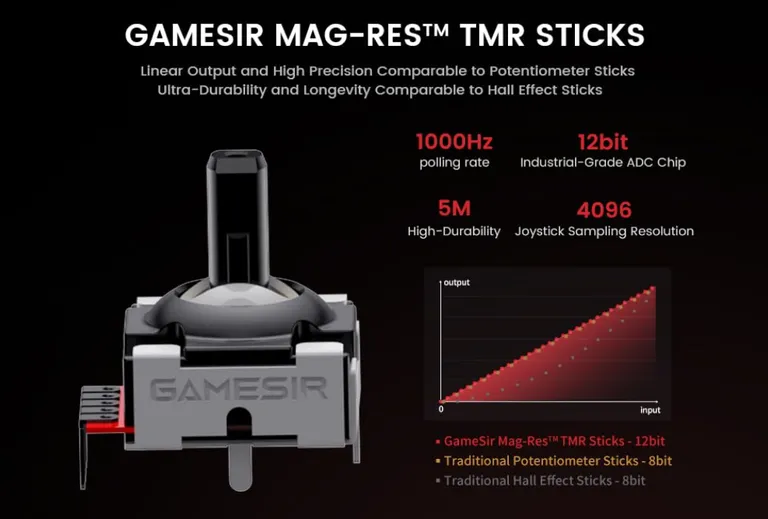
TMR vs Hall effect vs potentiometer sticks
| Feature | Potentiometer | Hall effect | TMR |
|---|---|---|---|
| How it senses | Wiper on a resistive track | Magnet + Hall sensor (voltage) | Magnet + tunnel junction (resistance) |
| Contact / wear | Yes — wears out | Contactless | Contactless |
| Stick drift | Common over time | Very unlikely | Very unlikely |
| Power draw (per sensor) | Low | ~0.5–2 mA | ~0.1–0.3 mA |
| Fits original pads without mods | Yes (stock part) | Usually needs circuit changes | Yes, with soldering |
| Precision in a real controller | Good when new | Limited by the controller’s ADC | Limited by the controller’s ADC |
| Dead zone | Grows as it wears | Minimal | Minimal |
| Price | Cheapest | Mid | Mid — now in $30–60 pads |
Which is better: TMR or Hall effect?
If you’re choosing between two controllers, the stick sensor shouldn’t be the deciding factor. TMR wins on power efficiency, which shows up as slightly longer battery life. Durability, drift resistance and precision are on par with a good Hall effect stick. Things like polling rate, latency, stick tension, back buttons and build quality matter more.
Where TMR clearly wins is modding: if you want to fix drift in your own DualSense, Xbox or Switch Pro controller, TMR modules are the best replacement because they work with the original board. See TMR stick modules.
FAQ
Are TMR joysticks Hall effect?
No. Both are magnetic and contactless, but they use different sensors. A Hall effect stick measures the voltage a magnetic field creates across a semiconductor. A TMR stick measures how the resistance of a tunneling magnetoresistive sensor changes with the magnetic field.
Are TMR sticks better than Hall effect?
A little. They draw much less power, which helps battery life and lets TMR modules drop into original PlayStation, Xbox and Switch Pro controllers. Durability is the same: neither wears out like a potentiometer stick. In real controllers the precision is about the same too, because the controller’s MCU and ADC decide the final resolution.
Do TMR joysticks drift?
They don’t wear out like potentiometer sticks, so they don’t get the classic stick drift. A brand-new controller can still need calibration or a small deadzone, depending on its firmware.
What does TMR stand for on a controller?
TMR stands for tunneling magnetoresistance. On a controller box, “TMR sticks” or “TMR joysticks” means the analog sticks use TMR sensors instead of potentiometers or Hall effect sensors.
Which controllers have TMR sticks?
There are 61 on our full list of TMR controllers: GameSir, 8BitDo, GuliKit, Razer, SCUF, ASUS ROG, EasySMX and more. See also the PS5 and Xbox lists.
Can I upgrade my controller to TMR sticks?
Yes. GuliKit, K-Silver, Ginful and HALLPI sell TMR modules for DualSense, DualShock 4, Xbox and Switch Pro controllers, and ElecGear makes them for the Steam Deck. See our TMR stick modules guide.